top of page
MANAGEMENT TOOLS

ICU tools that help the intensivists and the managers of critical care units to better administer the unit based on international standards of care. Tools includes ICU care processes, procedures, monitoring, documentations, and more..

Empiric ICU management of adult VAP. Treat as higher MDR risk — start broad with MRSA and antipseudomonal cover, layer a newer β-lactam / β-lactamase-inhibitor when resistant gram-negatives are likely, then de-escalate hard at 48–72 hours.
Ventilator-associated Pneumonia

Empiric ICU management of adult VAP. Treat as higher MDR risk — start broad with MRSA and antipseudomonal cover, layer a newer β-lactam / β-lactamase-inhibitor when resistant gram-negatives are likely, then de-escalate hard at 48–72 hours.

0

A time-critical CNS emergency. Draw blood cultures and start empiric antibiotics — with dexamethasone and acyclovir when indicated — immediately; never wait on CT or LP to treat. Risk-stratify the lumbar puncture, cover by age and host (Listeria, Pseudomonas, HSV), manage raised ICP and seizures, and engage ID, Neurology, and Neurosurgery early.
Meningitis & Meningoencephalitis

A time-critical CNS emergency. Draw blood cultures and start empiric antibiotics — with dexamethasone and acyclovir when indicated — immediately; never wait on CT or LP to treat. Risk-stratify the lumbar puncture, cover by age and host (Listeria, Pseudomonas, HSV), manage raised ICP and seizures, and engage ID, Neurology, and Neurosurgery early.

0

ICU management of acute ischemic stroke, ICH, and SAH. Blood-pressure targets diverge sharply by stroke type and reperfusion status — confirm the diagnosis and what was given before choosing a BP goal. Document last-known-well, run frequent neuro checks, and adapt every threshold to your stroke protocol and the individual patient.
Acute Ischemic Stroke

ICU management of acute ischemic stroke, ICH, and SAH. Blood-pressure targets diverge sharply by stroke type and reperfusion status — confirm the diagnosis and what was given before choosing a BP goal. Document last-known-well, run frequent neuro checks, and adapt every threshold to your stroke protocol and the individual patient.

0

CU management of adult status epilepticus. Run a time-driven ladder — a benzodiazepine now, an IV antiseizure load without waiting, then continuous anesthetic for refractory seizures — while stabilizing the airway and hunting the cause in parallel.
Status Epilepticus

CU management of adult status epilepticus. Run a time-driven ladder — a benzodiazepine now, an IV antiseizure load without waiting, then continuous anesthetic for refractory seizures — while stabilizing the airway and hunting the cause in parallel.

0

ICU management of severe CAP. Start oxygen and the sepsis bundle early, draw cultures but never delay the first antibiotic dose, and choose empiric coverage by MRSA and Pseudomonas risk. Send the full microbiology panel up front so therapy can be narrowed at 48–72 hours.
Severe Community Acquired Pneumonia

ICU management of severe CAP. Start oxygen and the sepsis bundle early, draw cultures but never delay the first antibiotic dose, and choose empiric coverage by MRSA and Pseudomonas risk. Send the full microbiology panel up front so therapy can be narrowed at 48–72 hours.

0

ICU management of acute PE. Risk-stratify by hemodynamics and RV strain, anticoagulate immediately unless contraindicated, and reserve systemic thrombolysis for massive PE with shock. Support the failing RV cautiously — avoid over-resuscitation — engage the PERT early, and keep reversal and bleeding orders one click away.
Pulmonary Embolism

ICU management of acute PE. Risk-stratify by hemodynamics and RV strain, anticoagulate immediately unless contraindicated, and reserve systemic thrombolysis for massive PE with shock. Support the failing RV cautiously — avoid over-resuscitation — engage the PERT early, and keep reversal and bleeding orders one click away.

1

ICU management of cardiogenic shock. Establish invasive monitoring, define the hemodynamic profile by echo ± PAC, and restore perfusion with norepinephrine and an inotrope rather than reflexive fluids. Identify and treat the cause — emergent revascularization for ACS — and escalate early to mechanical circulatory support for shock refractory to optimized vasoactive medications.
Cardiogenic Shock

ICU management of cardiogenic shock. Establish invasive monitoring, define the hemodynamic profile by echo ± PAC, and restore perfusion with norepinephrine and an inotrope rather than reflexive fluids. Identify and treat the cause — emergent revascularization for ACS — and escalate early to mechanical circulatory support for shock refractory to optimized vasoactive medications.

0

ICU management of severe, refractory asthma exacerbation. Front-load continuous β-agonists, ipratropium, and early systemic steroids; add IV magnesium and rescue agents for poor responders. If ventilation is needed, protect against dynamic hyperinflation — low rate, prolonged expiration, permissive hypercapnia — and reach for ketamine.
Status Athmaticus

ICU management of severe, refractory asthma exacerbation. Front-load continuous β-agonists, ipratropium, and early systemic steroids; add IV magnesium and rescue agents for poor responders. If ventilation is needed, protect against dynamic hyperinflation — low rate, prolonged expiration, permissive hypercapnia — and reach for ketamine.

0
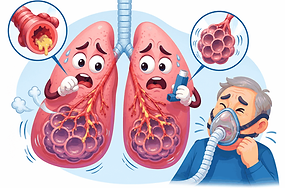
ICU / step-down management of AECOPD with acute-on-chronic hypercapnic respiratory failure. Controlled oxygen to 88–92%, early NIV, and the bronchodilator–steroid–antibiotic triad are the backbone — escalate to intubation on clear failure criteria, and ventilate the obstructed lung with a long expiratory time and permissive hypercapnia.
Acute Exacerbation of COPD

ICU / step-down management of AECOPD with acute-on-chronic hypercapnic respiratory failure. Controlled oxygen to 88–92%, early NIV, and the bronchodilator–steroid–antibiotic triad are the backbone — escalate to intubation on clear failure criteria, and ventilate the obstructed lung with a long expiratory time and permissive hypercapnia.

0

ICU management of acute pulmonary edema. Support oxygenation first — early NIV for cardiogenic edema — then diurese, offload with vasodilators when the pressure tolerates it, and support the failing pump. Classify cardiogenic vs noncardiogenic early and treat the underlying cause.
Pulmonary Edema

ICU management of acute pulmonary edema. Support oxygenation first — early NIV for cardiogenic edema — then diurese, offload with vasodilators when the pressure tolerates it, and support the failing pump. Classify cardiogenic vs noncardiogenic early and treat the underlying cause.

0

ICU management of VT storm — ≥ 3 sustained VT/VF episodes in 24 h requiring intervention. Stabilize the airway and hemodynamics, terminate unstable rhythms electrically, and break the catecholamine-driven cycle with antiarrhythmics, beta-blockade, deep sedation, and aggressive electrolyte correction. Engage EP early and escalate to ablation or mechanical support for refractory storm.
Ventricular Storm

ICU management of VT storm — ≥ 3 sustained VT/VF episodes in 24 h requiring intervention. Stabilize the airway and hemodynamics, terminate unstable rhythms electrically, and break the catecholamine-driven cycle with antiarrhythmics, beta-blockade, deep sedation, and aggressive electrolyte correction. Engage EP early and escalate to ablation or mechanical support for refractory storm.

0

ICU management of atrial fibrillation with rapid ventricular response. Triage hemodynamics first — unstable AF goes to synchronized cardioversion. Optimize electrolytes, choose a rate- or rhythm-control strategy by the patient's heart function, treat the underlying trigger, and weigh thromboembolic against bleeding risk.
Atrial Fibrillation with RVR

ICU management of atrial fibrillation with rapid ventricular response. Triage hemodynamics first — unstable AF goes to synchronized cardioversion. Optimize electrolytes, choose a rate- or rhythm-control strategy by the patient's heart function, treat the underlying trigger, and weigh thromboembolic against bleeding risk.

0

  • 9
    Page 4
bottom of page