
The BALANCE Trial: Is Seven Days Enough for Bloodstream Infections?


A 68-year-old man with diabetes and chronic kidney disease was admitted to the ICU in septic shock due to Escherichia coli bacteremia from a urinary source. He was treated with intravenous ceftriaxone. After 48 hours, his hemodynamics stabilized and inflammatory markers improved. On day 5, he was afebrile, off vasopressors, and ready for transfer to the ward. How long would you use antibiotics for?
How long would you use antibiotic therapy for this patient?
0%7 days
0%10 days
0%14 days
The BALANCE Trial
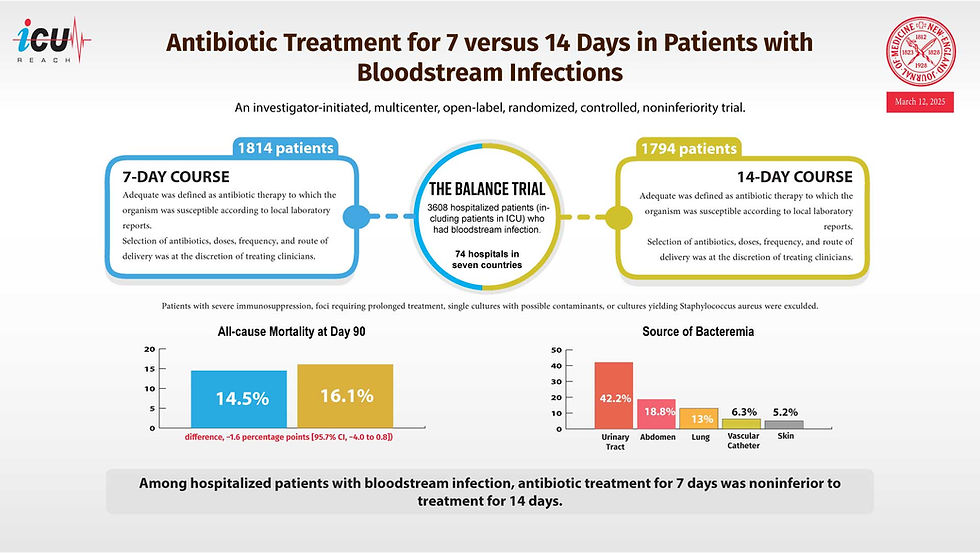
The Bacteremia Antibiotic Length Actually Needed for Clinical Effectiveness (BALANCE) trial, published in The New England Journal of Medicine in 2025, provided robust evidence to guide antibiotic duration in bloodstream infections. This multicenter, randomized, noninferiority trial enrolled 3,608 hospitalized adults, over half of whom were critically ill in ICUs, across 74 hospitals in seven countries. Patients with Staphylococcus aureus, prosthetic infections, or undrained abscesses were excluded.
Participants were randomized to receive 7 or 14 days of appropriate antibiotic therapy. At 90 days, mortality was 14.5% in the 7-day group and 16.1% in the 14-day group (difference, −1.6 percentage points; 95.7% CI, −4.0 to 0.8), confirming noninferiority. Relapse, Clostridioides difficile infection, and antimicrobial resistance were comparable between groups. Patients assigned to 7 days had more antibiotic-free days by day 28 (median 19 vs. 14). These findings were consistent across infection sources and clinical subgroups, including ICU patients.
The investigators concluded that, in most hospitalized patients with bloodstream infections, antibiotic therapy for 7 days was as effective as 14 days, provided that clinical stability was achieved and the source was controlled.
Expert Perspective
In an accompanying editorial, Dr. Vance Fowler described the BALANCE trial as a landmark study that challenges entrenched clinical practice. He highlighted its methodological rigor—spanning a decade of enrollment, a large and diverse patient population, and a narrow noninferiority margin of four percentage points—as evidence of its reliability and generalizability. Approximately 70% of participants had gram-negative bacteremia (predominantly E. coli or Klebsiella), three quarters had community-acquired infections, and over half were treated in ICUs, making the trial highly applicable to real-world critical care settings.
Dr. Fowler noted that despite the open-label design, the pragmatic execution reflected everyday decision-making. Nearly one quarter of patients in the 7-day arm received longer therapy than assigned, demonstrating persistent clinical hesitation to abbreviate treatment despite emerging evidence. Nevertheless, both the intention-to-treat and per-protocol analyses confirmed the safety and efficacy of the 7-day approach. He also emphasized that while the trial excluded high-risk groups such as S. aureus or immunocompromised patients, its findings should reassure clinicians that shorter courses can be appropriate for the majority of bloodstream infections.
Clinical Insights
The BALANCE trial and its editorial commentary collectively reinforce a key principle in antimicrobial stewardship: antibiotic duration should be driven by evidence and patient response, not by convention. For patients like the ICU case described, who stabilize after a few days of ceftriaxone and achieve source control, there is no survival or relapse benefit in extending therapy to 14 days. Prolonged antibiotic courses add unnecessary exposure, cost, and risk of resistance without measurable clinical gain.
This evidence supports a culture shift toward individualized, evidence-based prescribing. Shorter antibiotic durations—when guided by clinical improvement, microbiologic clearance, and adequate source management—can maintain efficacy while advancing stewardship goals. The BALANCE trial now provides the foundation to make that change with confidence.
References
Daneman N et al. Antibiotic Treatment for 7 versus 14 Days in Patients with Bloodstream Infections. N Engl J Med. 2025;392:1065–1078.
Fowler VG Jr. Eight Days a Week — BALANCING Duration and Efficacy. N Engl J Med. 2025;392:1136–1137.


Comments